
In today’s world, data doesn’t just support decisions—it drives them. And as a Business Analyst, I’ve learned that if you want to stay relevant, it’s not enough to understand the business. You have to understand the data too.
That’s exactly how I work.
Over the years, I’ve managed business analysis, implementation, and process improvement projects. But more and more, I found myself digging into the data—not just to validate assumptions, but to guide decisions. I wasn’t just translating requirements anymore. I was spotting patterns, testing hypotheses, and asking better questions. In other words, I started working like a data analyst—without dropping the business hat.
Real-World Example: Using Data to Uncover Customer Drop-Off
In a customer onboarding project for a SaaS product, the business team believed users were abandoning the signup flow due to poor design. A redesign was already in discussion. But before jumping in, I asked for access to the event tracking data.
By analyzing user behavior across each onboarding step, I spotted something unexpected: the biggest drop-off wasn’t at a UI hurdle—it was happening after users submitted their company details. Further digging showed the delay was due to a lag in account verification, which relied on an external API with inconsistent response times.
This wasn’t a design issue. It was a backend performance problem.
We solved it by caching verification responses and adding progress feedback for the user. Conversion rates improved by 18%—with no redesign required.
Making Better Decisions With Data Context
I’ve learned that a dashboard only tells you what, not why. To get to the why, you need to understand how the data is structured, how it’s generated, and what assumptions are baked in. I take the time to validate data sources, question logic, and understand the upstream process behind every number.
This matters. It prevents misinterpretation, avoids misleading KPIs, and builds trust in the outputs.
My Approach
-
Ask better business questions
Good analysis starts with the right questions. I make sure they’re specific, measurable, and rooted in actual business goals. -
Collaborate with data teams
I speak their language. Whether it’s SQL queries, data modeling, or transformation logic, I can follow the trail and work alongside analysts and engineers without friction. -
Close the loop
Insights only matter if they lead to action. I stay involved post-analysis to ensure the business adopts the findings—and that the change actually sticks.
Bridging Two Worlds
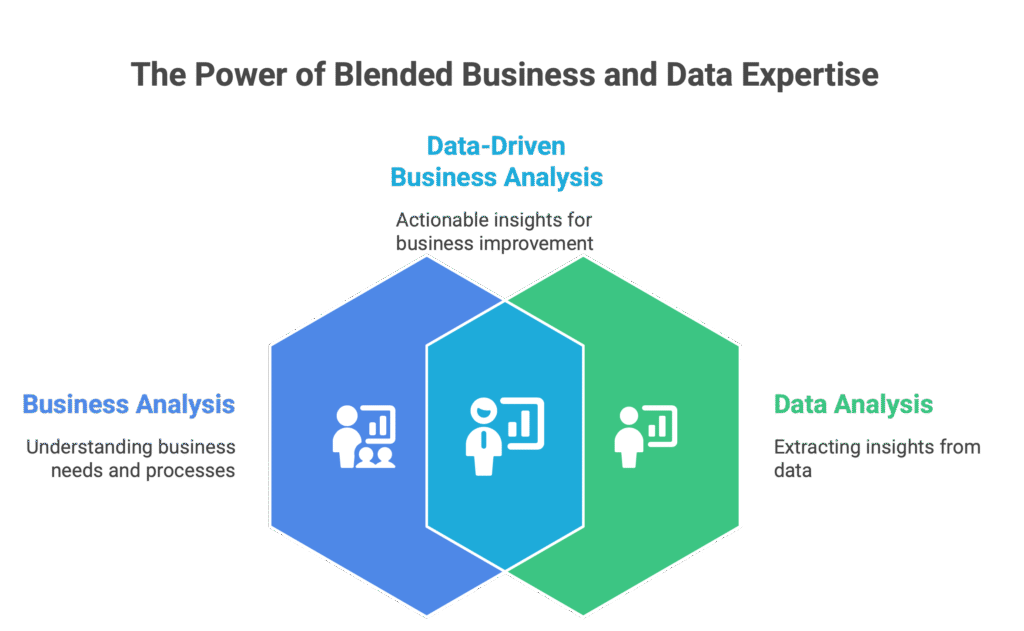
My sweet spot is the intersection of business process and data insight. I’m comfortable with stakeholders and spreadsheets, but I also enjoy digging into the logic of a report or understanding how data flows through a system. I don’t need to be the one writing complex models—but I can read them, question them, and guide them toward business value.
So if you’re looking for a BA who also thinks like a data analyst—who understands the business and the backend—you’re not looking for two hires. Just one.