
The Project Management Professional (PMP) certification stands as the gold standard in project management, recognized globally by employers and held by over 1.6 million professionals worldwide. If you’re considering this prestigious certification, understanding the exam’s cost structure, format, and content domains is essential for effective preparation and success.
PMP Exam Cost Breakdown
Exam Fees
The cost of taking the PMP exam varies significantly based on your PMI (Project Management Institute) membership status:
For PMI Members:
- Exam fee: $405 USD
- PMI membership: $129 per year (plus $10 first-time application fee)
- Total first-year cost: $544
For Non-Members:
- Exam fee: $675 USD (as of August 2025)
The math is clear: becoming a PMI member saves you $131 on your first exam attempt, even after accounting for the membership fee. Additionally, PMI membership provides valuable benefits including free access to the PMBOK Guide, exclusive webinars, professional development resources, and networking opportunities with project management professionals worldwide.
Additional Costs to Consider
Beyond the exam fee, budget for these potential expenses:
Training and Preparation:
- PMP training courses: $500 – $3,000 (required to earn 35 contact hours)
- Study materials and practice exams: $50 – $300
- PMBOK Guide: Free for PMI members, $47.98 for non-members
Retake Fees (if needed):
- PMI members: $275 per attempt
- Non-members: $375 per attempt
- Note: You can take the exam up to three times within your one-year eligibility period
Rescheduling/Cancellation:
- PMI charges fees for changes made within 30 days of your scheduled exam date
Time Investment: Most candidates spend 150-200 hours preparing for the exam over 8-12 weeks, which represents a significant personal investment alongside the financial costs.
PMP Exam Format and Structure
Basic Exam Details
The PMP exam is a computer-based test with the following specifications:
- Total Questions: 180 questions
- Scored Questions: 175 (5 are unscored pretest questions used for future exam development)
- Time Limit: 230 minutes (3 hours and 50 minutes)
- Breaks: Two optional 10-minute breaks
- First break: After completing questions 1-60
- Second break: After completing questions 61-120
- Average Time per Question: Approximately 77 seconds
The exam can be taken either:
- At a Testing Center: Through authorized Pearson VUE testing centers worldwide
- Online Proctored: From your home or office with remote proctoring via Pearson VUE
Question Types
The PMP exam includes diverse question formats designed to test practical application of project management knowledge:
Multiple Choice (Single Answer)
- Traditional format with four options and one correct answer
- Most common question type on the exam
Multiple Response (Multiple Answers)
- May have more than four answer choices
- Requires selecting multiple correct answers
- Question will specify how many answers to select
Matching
- Match items from one column to another
- Tests understanding of relationships between concepts
Hotspot
- Click on a specific area of an image or diagram
- Often used for questions involving charts, graphs, or process flows
Fill-in-the-Blank
- Type in the answer without multiple-choice options
- Less common but tests precise knowledge
- May involve calculations or specific terminology
Drag-and-Drop
- Arrange items in correct order or categories
- Tests understanding of sequences and classifications
Question Categories
Questions are designed to assess three levels of understanding:
Knowledge-Based Questions: Test your understanding of project management concepts, models, artifacts, and methods from the PMBOK Guide. These are the most straightforward questions but represent a smaller portion of the exam.
Scenario-Based Questions: Present real-world project situations requiring you to apply knowledge to determine the best course of action. These questions often feature complex situations where multiple answers might seem correct, testing your judgment and experience.
Math-Based Questions: Involve calculations related to project management processes such as earned value management (EVM), estimation techniques, critical path method (CPM), and risk analysis. While mathematical questions appear on the exam, they’re not as prevalent as scenario-based questions.
Scoring System
PMI uses a sophisticated psychometric analysis system rather than a simple percentage score. Instead of receiving a numerical score, you’ll receive performance ratings across the three domains:
- Above Target: Exceeded expectations in this domain
- Target: Met expectations in this domain
- Below Target: Partially met expectations in this domain
- Needs Improvement: Did not meet expectations in this domain
To pass, you need to score 141 out of 175 scored questions correctly (approximately 61%). However, PMI doesn’t reveal the exact passing threshold, as it may vary slightly based on exam difficulty through psychometric analysis.
The Three Performance Domains
In 2021, PMI restructured the PMP exam from five process groups to three performance domains that better reflect how project managers work in modern organizations. These domains emphasize practical skills over memorization of processes.
Domain I: People (42% of Exam)
Approximately 76 questions
The People domain represents the most significant shift in modern project management, emphasizing the critical importance of leadership, team dynamics, and stakeholder management. This domain focuses on the human side of project management—skills that traditional project managers often overlooked.
Key Topics Include:
Leadership Skills:
- Servant leadership principles
- Situational leadership and adapting leadership styles
- Emotional intelligence and self-awareness
- Creating psychologically safe environments
Team Management:
- Building and developing high-performing teams
- Team development models (Tuckman’s stages: forming, storming, norming, performing, adjourning)
- Empowering team members and delegation
- Managing distributed and virtual teams
Conflict Management:
- Conflict resolution techniques (collaborating, compromising, accommodating, avoiding, competing)
- Addressing underperformance constructively
- Negotiation skills and win-win outcomes
Stakeholder Engagement:
- Identifying and analyzing stakeholders
- Managing stakeholder expectations and communications
- Building relationships and trust
- Navigating complex organizational politics
What to Expect: Questions in this domain often present scenarios where you must choose the best approach to motivate team members, handle interpersonal conflicts, address underperformance, or navigate complex stakeholder relationships. The emphasis is on collaboration, empathy, and effective communication rather than command-and-control management.
Domain II: Process (50% of Exam)
Approximately 90 questions
The Process domain represents the technical backbone of project management, covering the methodologies, tools, and techniques used to deliver projects successfully. This domain comprises the largest portion of the exam and requires deep understanding of both traditional (predictive) and agile approaches.
Key Topics Include:
Project Planning:
- Scope definition and Work Breakdown Structure (WBS)
- Schedule development and critical path method
- Budget estimation and cost management
- Resource planning and allocation
- Risk identification and analysis
Project Execution:
- Managing project work and deliverables
- Quality assurance and control
- Communications management
- Procurement and vendor management
- Issue management and problem-solving
Monitoring and Controlling:
- Earned Value Management (EVM) and performance metrics
- Change control processes
- Quality control and continuous improvement
- Risk monitoring and response
- Integrated change control
Project Closure:
- Final deliverable acceptance
- Lessons learned documentation
- Resource release and contract closure
- Knowledge transfer and archiving
Methodology Balance:
- 50% Predictive (Waterfall): Traditional sequential approach
- 50% Agile/Hybrid: Iterative, adaptive approaches including Scrum, Kanban, and hybrid models
What to Expect: Process questions test your ability to apply appropriate tools and techniques to specific situations. You’ll need to understand when to use different approaches, how to calculate key metrics, and how to integrate various knowledge areas. Many questions are ITTO-based (Inputs, Tools & Techniques, Outputs) requiring knowledge of the PMBOK Guide processes.
Domain III: Business Environment (8% of Exam)
Approximately 14 questions
While the smallest domain by percentage, Business Environment is crucial as it addresses the project manager’s strategic role in aligning projects with organizational goals. This domain tests your understanding of the broader business context in which projects operate.
Key Topics Include:
Strategic Alignment:
- Linking projects to organizational strategy
- Benefits realization and value delivery
- Portfolio and program management concepts
- Business case development and justification
Organizational Structures:
- Understanding organizational types (functional, matrix, projectized)
- Navigating organizational culture and politics
- Working within organizational frameworks
- Change management and organizational change
Compliance and Governance:
- Regulatory requirements and industry standards
- Ethical considerations and professional responsibility
- Project governance frameworks
- Compliance monitoring and reporting
External Environment:
- Market conditions and competitive landscape
- External dependencies and constraints
- Environmental and social factors
- Globalization and cultural considerations
What to Expect: Business Environment questions often require you to think beyond the project itself to consider organizational impact, strategic value, and external factors. You may need to evaluate how projects support business objectives, how to navigate organizational politics, or how to ensure compliance with regulations.
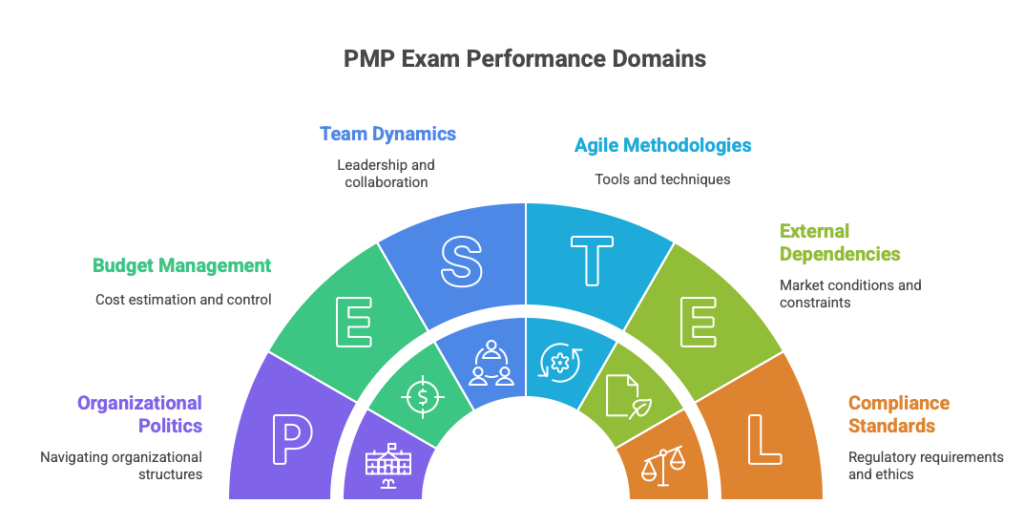
Methodology Distribution: Predictive vs. Agile
A critical aspect of the modern PMP exam is its balanced coverage of project management approaches:
- 50% Predictive (Traditional/Waterfall): Sequential, plan-driven methodology
- 50% Agile/Hybrid: Iterative, adaptive methodologies including Scrum, Kanban, SAFe, and hybrid approaches
This distribution reflects the reality that modern project managers must be fluent in multiple methodologies and able to select the most appropriate approach for each project. Questions don’t separate predictive from agile into distinct sections—instead, both approaches are woven throughout all three domains.
Effective Study Strategies
Time Allocation Based on Domain Weight
Allocate your study time proportionally to the exam domains:
- Process Domain: 50% of study time (~75-100 hours)
- People Domain: 42% of study time (~65-85 hours)
- Business Environment: 8% of study time (~12-15 hours)
Focus Areas for Maximum Impact
- Master the PMBOK Guide and Agile Practice Guide: These form the foundation of the exam content
- Practice with Realistic Simulators: Use exam simulators that mirror the actual test format, including all question types
- Understand, Don’t Memorize: Focus on comprehension and application rather than rote memorization
- Take Full-Length Practice Exams: Simulate exam conditions to build stamina and time management skills
- Review Weak Areas: After practice exams, focus additional study on domains where you scored lower
Time Management During the Exam
A proven strategy is the 80-80-70 rule:
- First 60 questions: 80 minutes (1 minute 20 seconds per question)
- Second 60 questions: 80 minutes
- Final 60 questions: 70 minutes
- Remaining time: Review marked questions
Remember, you have approximately 77 seconds per question on average, but some complex scenario questions may require more time while straightforward questions may take less.
Is the PMP Worth the Investment?
The numbers speak for themselves:
- Salary Premium: PMP certification holders earn a median salary 33% higher than non-certified project managers in the United States
- Global Recognition: Recognized in over 190 countries as the premier project management credential
- Career Advancement: Opens doors to senior project management roles and leadership positions
- Job Market Demand: PMI projects that by 2027, organizations will need approximately 88 million individuals in project management roles globally
- Professional Credibility: Demonstrates advanced knowledge and commitment to the profession
Return on Investment Timeline
Consider the average investment:
- Total cost: $544 – $1,000 (including exam, membership, and prep materials)
- Time investment: 150-200 hours over 2-3 months
With a 33% salary increase, most PMP holders recoup their investment within the first year. Even a modest $10,000 annual salary increase means the certification pays for itself multiple times over throughout your career.
Final Preparation Tips
- Create a Study Schedule: Develop a realistic 8-12 week study plan and stick to it
- Join Study Groups: Connect with other PMP aspirants for motivation and knowledge sharing
- Use Official Resources: Leverage PMI resources, including the PMBOK Guide, Agile Practice Guide, and PMI.org materials
- Take Care of Yourself: The week before the exam, reduce intense studying, get adequate sleep, and maintain regular exercise
- Exam Day Preparation: Arrive early (or set up your testing space early for online exams), bring required identification, and trust your preparation
Conclusion
The PMP certification represents a significant investment of time, money, and effort—but it’s an investment that pays substantial dividends throughout your project management career. By understanding the exam’s cost structure, format, and the three performance domains, you can develop an effective study strategy that maximizes your chances of passing on the first attempt.
The modern PMP exam reflects the evolving role of project managers, emphasizing leadership, adaptability, and the ability to work with both traditional and agile methodologies. Whether you’re an experienced project manager seeking to validate your expertise or an aspiring project manager looking to advance your career, the PMP certification opens doors and provides the credibility needed to succeed in today’s competitive project management landscape.
Start your journey by joining PMI, earning your 35 contact hours through a quality training program, and developing a comprehensive study plan that covers all three domains. With dedication, the right resources, and effective preparation strategies, you’ll be well-positioned to join the ranks of over 1.6 million PMP-certified professionals worldwide.
Ready to begin your PMP journey? Visit PMI.org to learn more about eligibility requirements, register for the exam, and access official study resources. Your path to project management excellence starts today.