Communication is not just a soft skill; it is an essential tool that can rapidly improve the quality of every part of your life. As motivational speaker Brian Tracy notes, communication is a skill you can learn, much like riding a bicycle or typing—if you are willing to work at it.
For the Business Analyst (BA), effective communication is essential. BAs are invaluable to enterprise projects because they help improve overall productivity and drive the final outcome simply by communicating effectively. You apply your communication skills at every juncture of a project: during requirements elicitation, the project kickoff, liaisons with stakeholders, and the final solution delivery.
If you dedicate about 10 minutes to focusing on this topic, you can enhance your understanding of how communication impacts project outcomes.
The BA’s Core Communication Mandate
To ensure project success, BAs have vital communication responsibilities:
• You must communicate the stakeholder’s needs to the project team.
• You must ensure that those needs have been met at the conclusion of the project.
• You must actively work to break down barriers to communication—such as those related to time, attention, expectation, or language—that might occur between developers and stakeholders.
Essential Tips for Engaging Stakeholders
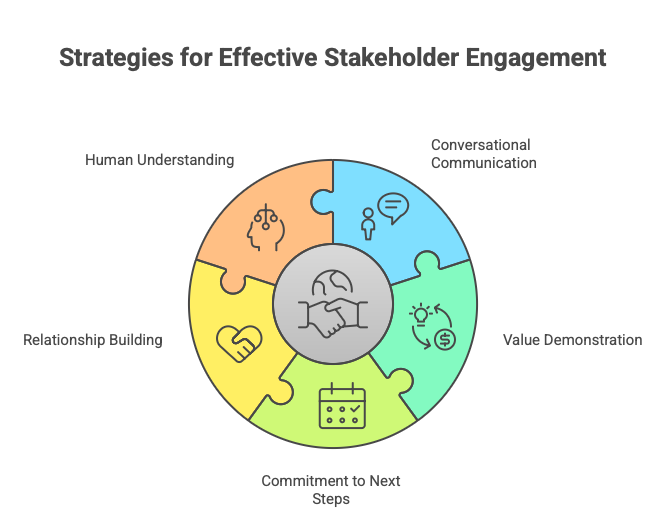
Successfully engaging stakeholders is crucial for achieving project goals. Here are a few essential approaches:
1. Communicate by Making It a Conversation Create a conversational tone. Ask questions and be sure to listen to the answers. You want to avoid making stakeholders feel cornered.
2. Share How You Can Help By showing how you can help, you allow the stakeholder to see your value as a business analyst. The more value they perceive, the easier it is to carry out the other parts of your job.
3. Get Commitment for Next Steps Acknowledge your stakeholders’ time in a respectful manner. While you want them engaged, you don’t want them to feel like they will be “sucked into endless questions” every time you meet. By explaining the necessary next steps and gaining their commitment, you demonstrate your own commitment and create a solid foundation for your professional relationship.
4. Develop Relationships Trust grows from developing relationships, and people work together more effectively when trust is established. Spend time developing these connections, and you will see a big return on investment.
5. Remember, We’re All Human Keep in mind that agendas may not always line up, and human feelings are involved. Humans can sometimes be inconsistent, unreasonable, irrational, or unpredictable. If you feel tension, try seeking the root cause of a stakeholder’s behavior. Assess if there are ways to change the dynamic to maintain a productive relationship, and always try to be understanding.
Communication Comes in All Forms
Communication is an art form that involves comprehending, processing, transferring information, listening, and reading. While it can be challenging, it is ever so important in a project. You can attain better project outcomes by developing the communication methods available to you.
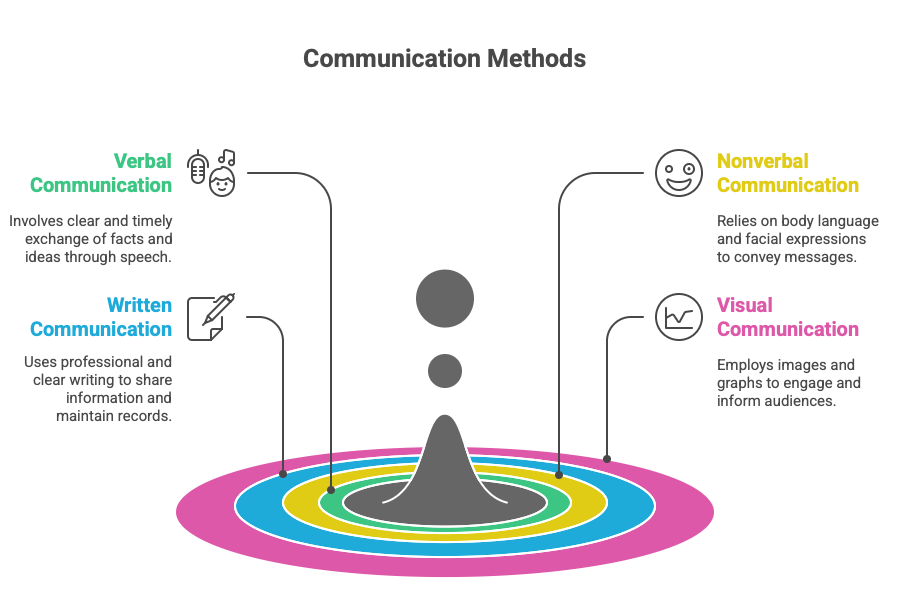
There are four core types of communication that help you attain better project outcomes:
1. Verbal Communication
Verbal communication is used to convey facts, opinions, and ideas. This occurs during conferences, presentations, meetings, and one-on-one conversations. It is critical because it helps you elicit and clarify information in a timely manner.
Tips for improving Verbal Communication:
Tip | Clarification |
Speak clearly and loudly | Enunciate your words and ensure everyone can hear you. |
Choose your words carefully | Use words that demonstrate your professionalism and intelligence, and ensure they are appropriate by anyone’s standards. |
Use an appropriate tone | Your tone, or the sound of your voice, speaks volumes about how you feel and what you are saying; make sure it matches the sentiment you intend to express. |
Consider your audience | A formal audience requires a more formal dialog, while you might speak less formally if you are quite familiar with the participants. |
Respond appropriately | Think before you speak and formulate your thoughts to help prevent the possibility of responding offensively. |
2. Nonverbal Communication
Nonverbal communication conveys information using facial expressions, gestures, and body language, without using sounds or words. While verbal communication is important, it comprises only a small part of communication, as most communication is nonverbal. Paying close attention to these cues can help you truly know what someone is saying and ensures you communicate the message you intend.
Areas to focus on to improve Nonverbal Communication:
Area | Rationale |
Eye contact | Maintaining eye contact shows you are focused and interested in the other person, but avoid staring. |
Personal space | Pay attention to your proximity and adjust accordingly; be aware that different cultures view proximity in various ways. |
Posture and movement | Be aware of your posture (slouching can be interpreted as disinterest) and avoid excessive body movements, like swinging your leg, which may make others uncomfortable. |
Openness of body | Keep your body in an open position; this suggests you are open to listening. Avoid crossing your arms over your body, as this may be interpreted as defensive. |
3. Written Communication
Writing is a critical form of communication for BAs, who provide a written record for reference, share information extensively, and keep groups and people in sync through emails, chats, blogs, memos, requirements, and documents. In the workplace, when more than one person is involved, you should always write professionally, using proper grammar, punctuation, and complete sentences.
Pointers for better written communication:
• Be clear and concise: The key is to be understood; be straightforward and factual.
• Don’t rely on tone: Maintain a professional tone in writing. Attempting to communicate through sarcasm, jokes, or even excitement can be taken negatively depending on your audience. Instead, be clear, concise, and straightforward, and save the personality for follow-up verbal communications.
• Take time to review: Because errors can be costly, reread your written correspondences before sending them. Try taking a break before reviewing; you may find a better way to convey something. For important or widely distributed communications, ask a trusted colleague to review.
• Develop a consistent writing style: Use an effective email, pamphlet, or document as a model to develop your own consistent style until you have absorbed it and no longer need the reference.
4. Visual Communication
Visual communication involves using visual media like sketches, images, graphs, and charts to convey information. This method is often helpful because most people are visual learners. You might use visuals to draw in your audience during a presentation or to show data effectively in a document.