
If you’ve worked as a Business Analyst long enough, this moment is inevitable:
“This project is in a domain I’ve never worked in before.”
Healthcare to fintech. Manufacturing to SaaS. Insurance to retail. And suddenly, confidence gives way to uncertainty.
Here’s the truth most people won’t say openly: Strong Business Analysts are not domain experts first. They are learning experts first.
Below are proven strategies that help Business Analysts not just survive—but excel—when working in a completely unfamiliar domain.
Shift Your Mindset: You’re Not Expected to Know—You’re Expected to Learn Fast
Many BAs panic because they assume domain ignorance equals poor performance. That’s false. Your real value lies in:
Asking the right questions
Structuring ambiguity
Translating business needs into clarity
🎯 Mindset hack:
“I may not know the domain yet, but I know how to discover it.”
This mindset alone changes how confidently you show up in stakeholder conversations.
Start With the “Why” Before the “What”
When entering a new domain, avoid jumping straight into: Requirements, Screens, Data fields
Instead, ask:
Why does this process exist?
What problem is the business trying to solve?
What happens if this fails?
📌 Why this works: Understanding intent helps you evaluate solutions even when terminology is new.
Create Your Own Domain Crash Course (Don’t Wait for One)
Most organizations won’t formally train you on the domain. So build your own. Effective ways to ramp up:
Read intro-level blogs, whitepapers, and FAQs
Watch YouTube explainers (not deep tech—conceptual ones)
Review past BRDs, user stories, SOPs
Understand industry regulations at a high level
⏳ You don’t need mastery.
You need working fluency.
Identify the Real Domain Experts Early
Every project has:
One SME who knows the process end-to-end
One stakeholder who understands business impact
One user who knows the pain points best
Your job is to map these people quickly.
💡 Pro tip: Ask each SME:
“If I had to understand only one thing about this domain to be effective, what should it be?”
Their answers reveal what truly matters.
Use Visuals to Bridge Domain Gaps
When terminology is unfamiliar, visual thinking becomes your superpower. Use:
Process flows
Context diagrams
System interaction maps
Simple before-and-after visuals
📈 Why visuals work:
Stakeholders correct you faster
Misunderstandings surface early
You learn the domain while documenting it
A BA who draws well learns faster than one who writes only.
Validate Assumptions Aggressively (and Publicly)
In a new domain, assumptions are unavoidable. What matters is how you handle them. Best practice:
Call them out explicitly
Validate them early
Invite correction
Example:
“My understanding is that X happens before Y—please correct me if I’m wrong.”
This shows humility and professionalism.
Focus on Business Rules Before Functional Details
In new domains, screens and fields change. Business rules rarely do. Ask:
What conditions trigger decisions?
What exceptions break the flow?
What rules are regulatory vs flexible?
Once you understand business rules, functional requirements fall into place.
Leverage Your “Outsider Advantage”
Ironically, being new to a domain can be a strength. You:
Question inefficient legacy processes
Spot assumptions insiders overlook
Ask “why” when others accept “that’s how it is”
🧠 Many breakthroughs come from fresh eyes, not long tenure.
Document Learnings Like Assets, Not Notes
Every insight you gain should be:
Documented
Structured
Reusable
Create:
A personal domain glossary
A decision log
A simplified domain overview deck
This positions you as someone who adds long-term value, not just delivers tasks.
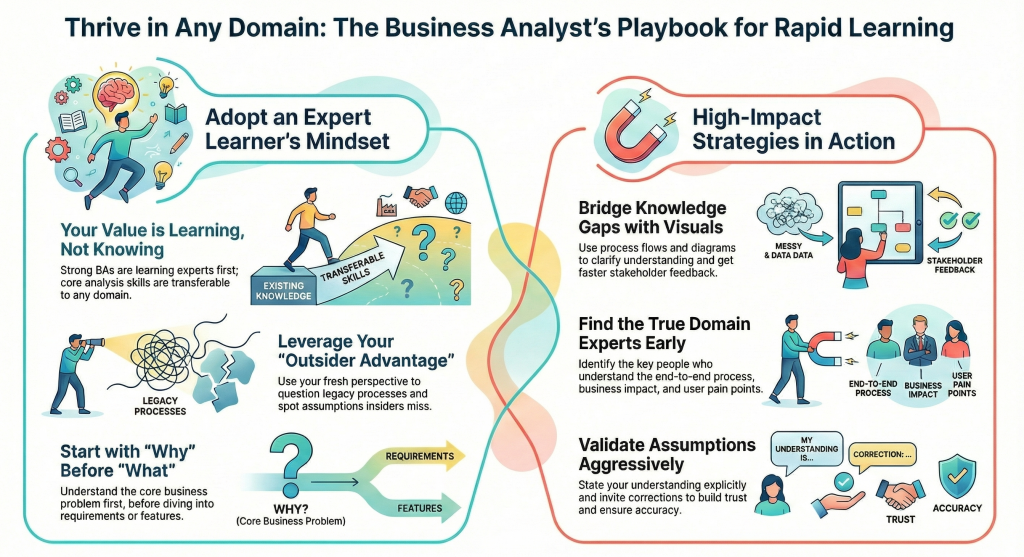
Remember: Domain Knowledge Is Temporary—BA Skills Are Transferable
Domains change. Tools change. Industries evolve. But these skills don’t:
Critical thinking
Stakeholder management
Requirements discovery
Problem structuring
A strong Business Analyst can walk into any domain—and create impact.
Final Thought 💡
The best Business Analysts are not defined by the domains they’ve worked in, but by how effectively they adapt when the domain is unfamiliar.
If you can learn fast, ask better questions, and structure chaos—you’re already ahead.