The Importance of Information Discovery :
Information discovery is identified as one of the most important phases in the project lifecycle, serving as the period when the business analyst (BA) performs most of the project groundwork. Having the right information is key to project success, as without it, the BA cannot form the best conclusions and bring a project to fruition. As writer Myra Kassim suggests, “In the absence of information, we jump to the worst conclusions”.
Project information is the crucial agent of change; it drives the solution and the ultimate change in the business. The ultimate goal for a skilled business analyst is to know the required types of information for each project and how to access it to reach the project goal.
Core Investigative Approach: The Six Questions
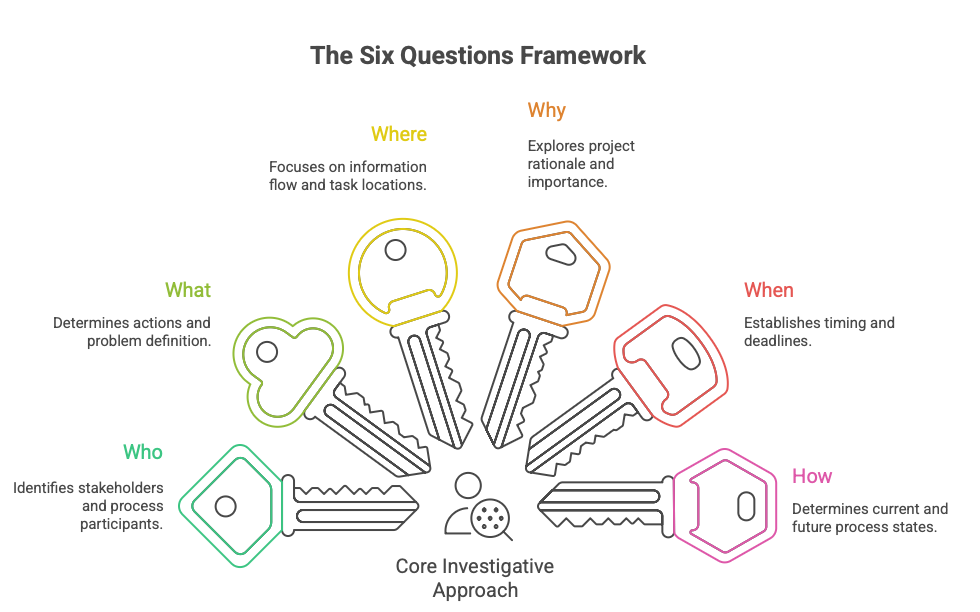
To gather the necessary data, a business analyst explores all areas of the project by asking as many questions as possible. This process typically involves asking every who, what, where, why, when, and how question about the subject.
These questions cover essential aspects of the business and the project need:
• Who: Identifies stakeholders, those involved, those who follow the process, and those who hand things off.
• What: Determines what is done first, what is done next, and what the core problem is that the team is trying to solve.
• Where: Focuses on where information is input, where it goes after input, and the location of a person performing a task.
• Why: Explores the rationale for the project, asking why the team is doing this and why it is important.
• When: Establishes the timing of events (e.g., once a week, every first day of the month) and when a solution is needed.
• How: Determines how the system or process currently works and how it should work in the desired future state.
The answers gathered through these questions provide the BA with a good cross section of data to move the project toward the best solution.
High-Level Categories for Finding Key Information
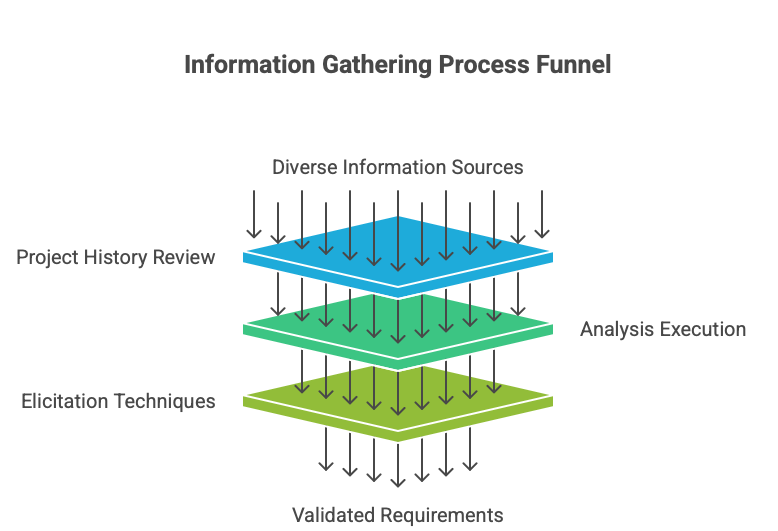
Information comes in many forms (including requirements, project information, processes, and analyses) and originates from countless sources, such as subject matter experts and stakeholders. These sources are grouped into three high-level categories:
1. Project History
2. Analysis
3. Elicitation
1. Project History (Project Orientation)
This involves gathering significant background information from stakeholders or other sources. It is crucial because it helps the BA understand existing systems, design, requirements, and business processes, ensuring that the team does not inadvertently repeat prior work or rehash previous decisions.
2. Analysis
The BA performs various analyses to learn and understand as much as possible about a project.
• Enterprise Analysis: This involves learning the organization’s structure, including reporting lines and the functions and interactions of various departments, which supports team communication and collaboration.
• Strategy Analysis: This aims to reach the heart of the problem by identifying the business need (of strategic or tactical importance), which guides the remainder of the project. This analysis includes:
◦ Observing the current state and defining the future and transition states.
◦ Performing a gap analysis to identify differences between the current and desired states.
◦ Assessing options for achieving the desired state and recommending the highest value approach.
◦ Assessing associated risks and developing action plans to address potential uncertainties that might affect the project lifecycle or end goal.
• Stakeholder Analysis: Stakeholders are internal or external individuals or groups who make decisions and determine project priorities and requirements. It is essential to identify them early, starting with anyone who has an interest in, or may be affected by, the issue under consideration. Stakeholders can include Internal roles like Owners, Managers, and Employees, and External roles such as Competitors, Customers, Partners, Suppliers, and Regulators.
3. Elicitation
Often, the business or technical requirements needed by a BA are not readily available or documented; they reside in the minds of stakeholders or end users. When information is not readily available, it must be elicited.
• Definition: In the business analyst world, information discovery is known as elicitation, which means “to draw forth or bring out”. The BABOK Guide defines it as “the drawing forth or receiving of information from stakeholders or other sources,” making it the main path to discovering requirements and design information.
• Techniques: The BA first determines the project needs and then selects the best elicitation method(s). Examples of elicitation techniques include:
◦ Brainstorming
◦ Document analysis
◦ Focus groups
◦ Interface analysis
◦ Interviews
◦ Observation
◦ Process modeling
◦ Prototyping
◦ Requirements workshops
◦ Surveys/questionnaires
• Process Stages: Elicitation is not isolated; it occurs during interaction with stakeholders and independent analytical work. It is typically performed in three general stages:
1. Prepare for elicitation: Gather a comprehensive understanding of the project’s business need.
2. Conduct elicitation: Meet with stakeholders to elicit information regarding their and the business’s needs.
3. Confirm elicitation results: Validate that the stated requirements match the problem and needs, ensuring the understanding conforms to the actual desires or intentions of the stakeholders.
Elicitation serves as the underlying research for the subsequent phase of the process: requirements creation.