
If you are aiming for a highly respected Project Manager or Business Analyst role, especially in the competitive remote job market, you’ve likely encountered the Project Management Professional (PMP) certification. This credential, offered by the Project Management Institute (PMI), is known worldwide as the gold standard for demonstrating project leadership expertise.
But what exactly does it mean, and is it the right investment for your career journey? Let’s break down the value, requirements, and common myths surrounding the PMP certification in simple, friendly language.
——————————————————————————–
1. What Exactly Is PMP Certification?
The PMP certification is a formal credential provided by the Project Management Institute (PMI). Earning it means you have demonstrated competence in the foundational knowledge, skills, tools, and techniques needed to effectively lead and direct project teams.
The certification focuses on mastering widely accepted project management principles and practices. While project management roles span every industry—from IT and healthcare to construction and finance—PMP certification provides a universal vocabulary and framework for how successful projects should be executed.
——————————————————————————–
2. The Value: Why Bother Getting Certified?
The PMP offers tangible benefits that can dramatically boost your professional profile, making it a worthwhile investment for career growth.
Significant Financial Return
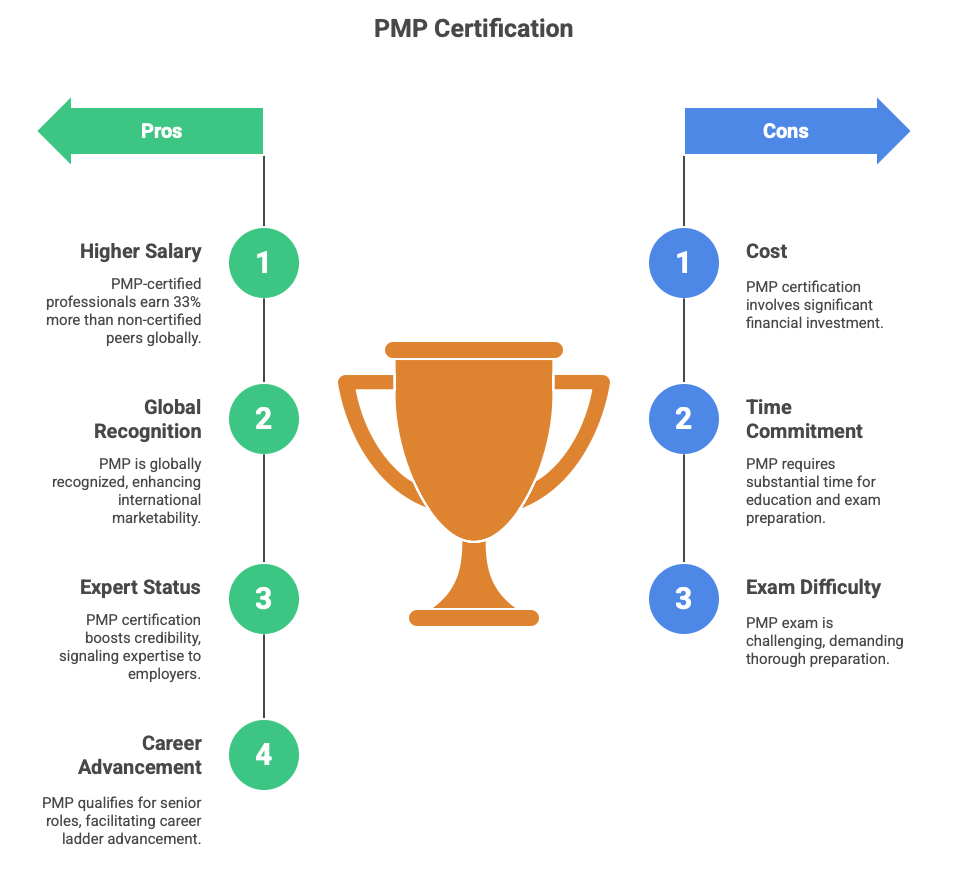
The clearest benefit of PMP certification is the immediate and long-term financial gain. According to PMI’s latest research, project management professionals holding the PMP certification report median salaries that are 33% higher on average than their non-certified peers globally.
In the United States, PMP-certified professionals report a median annual salary of $120,000. This salary premium often results in a massive return on investment (ROI), as the increase in pay can quickly recover the entire cost of obtaining the certification.
Enhanced Credibility and Employability
In many competitive sectors, the PMP has transitioned from being a distinguishing factor to being the minimum requirement, often called “table stakes”.
• Global Recognition: The PMP is globally recognized and respected across a wide range of industries, including IT, construction, finance, and healthcare, increasing your international marketability.
• Expert Status: Earning this certification instantly boosts your professional credibility and signals to potential employers that you are a dedicated expert who has invested time in the profession.
• Career Ladder Advancement: The PMP serves as a springboard for ongoing professional growth, qualifying you for mid- to senior-level positions, including Senior Project Manager, Program Manager, Portfolio Manager, and even Director-level roles within a Project Management Office (PMO).
3. Can You Apply? Eligibility Requirements
Because the PMP certifies competence in leading projects, it has rigorous prerequisites focused on combining formal education with real-world experience.
You must satisfy one of the following two paths:
|
Your Education Level |
Experience Required |
Project Management Education |
|
Four-Year Degree (Bachelor’s degree or global equivalent) |
36 months (4,500 hours) leading and directing projects |
35 hours of project management education/training |
|
Secondary Degree (High school diploma, Associate’s degree, or global equivalent) |
60 months (7,500 hours) leading and directing projects |
35 hours of project management education/training |
The Critical Note on Experience
It is crucial to understand that PMI is looking for experience where you have led or directed projects, meaning you were making important decisions and calling the shots, rather than just performing individual contributor or administrative work.
When you apply, PMI may randomly select your application for an audit to verify your education and experience. If audited, you must provide documentation, and the references you list must digitally verify your experience details.
4. Common Misconceptions & The Reality Check
While the PMP is highly valued, professionals often worry about the commitment required.
Misconception 1: It’s Just a Money Racket
The Reality: The PMP involves a substantial financial and time investment. The total cost, including the exam fee (which is discounted if you join PMI), training, and study materials, typically ranges from $1,200 to $5,500 USD.
Furthermore, maintaining the credential requires you to earn 60 Professional Development Units (PDUs) every three years.
However, PDU renewal does not have to be expensive. Many PMP holders use free resources like webinars and articles offered by PMI as part of their membership to fulfill the 60 PDU requirement, mitigating the recurring costs.
Misconception 2: The Exam is Based Purely on Experience
The Reality: The PMP exam is known for being rigorous and comprehensive. Preparing for it typically takes 3 to 6 months.
Many experienced professionals find they cannot rely solely on their real-world experience because the questions are often scenario-based and designed to test understanding of the “PMI mindset”—the globally accepted standard practices outlined in the PMBOK Guide. Successfully passing requires dedicated study and understanding of PMI’s best practices, not just operational habits.
Misconception 3: The PMP is the Only Way Forward
The Reality: While the PMP is the most globally recognized credential for experienced managers, it is not the only path:
• For Beginners: If you do not meet the experience requirements, the PMI offers the Certified Associate in Project Management (CAPM) certification. The CAPM is an entry-level credential that requires a secondary degree and only 23 hours of project management education, making it a useful stepping stone to the PMP later on.
• For Agile/Business Analysis Roles: Other alternatives like the PMI Agile Certified Practitioner (PMI-ACP) or certifications focused on Business Analysis (like PMI-PBA) or Scrum (like CSM or PSM) might be valuable depending on your specific job target within the tech sector.
——————————————————————————–
If you are committed to advancing into leadership roles or transitioning into remote project management and business analysis, pursuing the PMP certification is a strategic career investment that validates your existing experience, significantly enhances your earning potential, and solidifies your credibility in the global job market