Business analysts (BAs) are the fix-it people of the business world. Typically, they are members of a project management team and play a significant role in the project lifecycle. Their job is to help enable change in an enterprise.
The change can be big, like converting an acquired company’s financial system to SaaS based platform. Or the change can be something small, like enabling sales managers to make forecast adjustments. Or it can be something in between, like improving a business process or solving a current or future business problem. Whatever the scale, if the change involves improving or streamlining a process (business driven) or system (IT driven) to help organizations meet their target goals, a business analyst can steer the project in the right direction.
So how do you, as a business analyst, go about doing this? As Steve Blais wrote, business analysts are usually highly curious people who love to learn and who use what they learn to elevate their understanding. This understanding is key to driving a project forward. Business analysts are experts at learning, understanding, and recording needs.
In this article, you learn about the specialized approach that business analysts take to bring about change and improvement to the business. This involves eliciting, analyzing, and documenting information and employing communication strategies to ensure maximum collaboration among the project team.
Top Skills of the Business Analyst
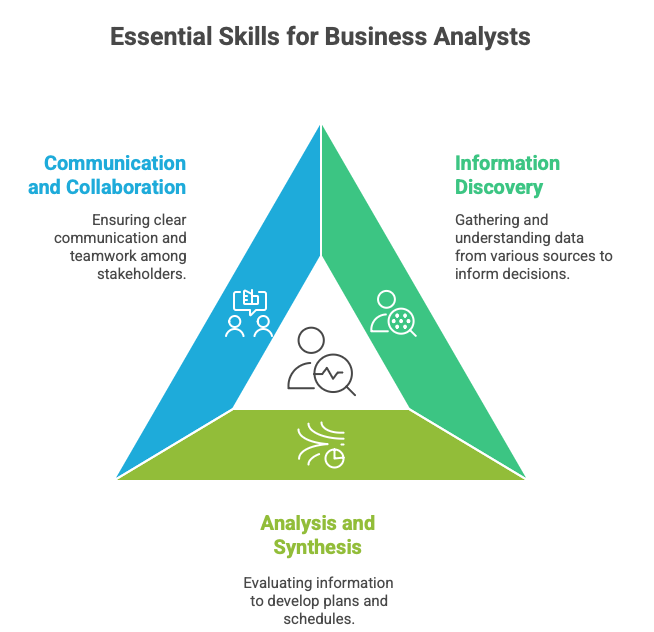
Let’s start with a high-level view of some of the most important skills that BAs use to work effectively with both people and information to facilitate a solution to a problem.
Information Discovery
To make informed decisions and recommendations, business analysts need to gather information, lots of information, from all levels. This is one of the most important steps in the business analyst process, so they must do it well.
Analysis and Synthesis
Business analysts spend significant effort looking through the information that they’ve gathered. They look at both the details and the high-level information to chart needs and to develop plans and schedules. They also look at the skills and experience of the people involved to determine how the team can best work together to achieve a successful outcome.
Communication, Collaboration, and Documentation
Business analysts must communicate clearly and efficiently to everyone involved. They need to document and share information so that stakeholders and other involved parties have a clear understanding of the project, the goals, and the proposed solution. BAs help improve overall productivity by breaking down the barriers to communication.
In this unit, you got a high-level look at what a successful business analyst does and some of the skills they use. We explore each of these skills in detail in the next units.