
As remote work becomes the norm across global teams, the role of the Business Analyst (BA) is evolving rapidly. Today, success as a BA isn’t just about knowing tools, creating user stories, or running sprints—it’s about how well you communicate, influence, and collaborate remotely.
In a digital world where face-to-face interaction is rare, soft skills have become just as critical—if not more—than technical skills for Business Analysts.
What Are Soft Skills in the BA Context?
Soft skills refer to interpersonal and communication abilities that help you work effectively with others. For Business Analysts in remote roles, key soft skills include:
-
Active Listening
-
Clarity in Communication
-
Empathy and Emotional Intelligence
-
Stakeholder Management
-
Facilitation and Influence
-
Adaptability and Self-Motivation
Let’s break down why these matter more than ever.
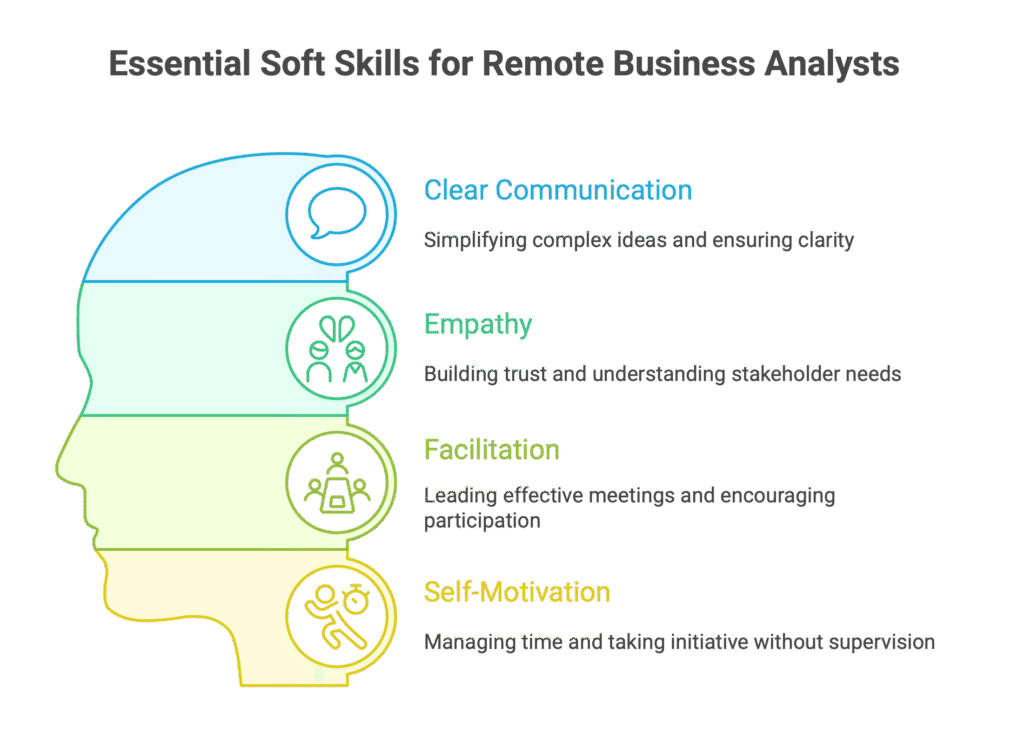
1. Clear Communication Cuts Through the Noise
In a remote setup, there are no whiteboard sessions, hallway conversations, or body language cues. Everything relies on:
-
Video calls
-
Written documentation
-
Slack or Teams messages
If you can’t explain ideas clearly, misunderstandings multiply—and project delays follow.
Great remote BAs simplify the complex, write crisp user stories, and ask clarifying questions when things get vague.
Soft Skill Tip: Practice summarizing long discussions in 3 bullet points during or after meetings.
2. Empathy Builds Stronger Virtual Relationships
Stakeholders are juggling time zones, distractions, and Zoom fatigue. Being empathetic means:
-
Respecting others’ constraints
-
Acknowledging stress or ambiguity
-
Being human—not robotic—in communication
Remote doesn’t mean impersonal. Emotional intelligence helps you build trust, reduce friction, and keep everyone aligned.
Soft Skill Tip: Open meetings with a personal check-in. It sets a collaborative tone.
3. Facilitation Is a Superpower in Virtual Settings
As a remote Business Analyst, you’re often the glue between business and tech. In remote environments, you must:
-
Host effective online workshops
-
Encourage quieter voices
-
Keep meetings structured and focused
Being a great facilitator leads to faster decisions and better engagement.
Soft Skill Tip: Use tools like Miro or MURAL to make meetings more interactive and inclusive.
4. Self-Motivation and Accountability Keep You On Track
Remote BAs don’t have someone checking over their shoulder. You need to:
-
Own your outcomes
-
Manage your time well
-
Follow through without micromanagement
High-performing BAs in remote roles proactively communicate progress, raise flags early, and show initiative.
Soft Skill Tip: End your week with a short update email to key stakeholders—even if it’s just a bullet list.
Final Thoughts: Soft Skills Are Your Remote Advantage
The tools and templates might be the same. But in a remote-first world, how you engage with people determines your impact.
The best Business Analysts today are not just system thinkers—they’re empathetic communicators, strong facilitators, and collaborative leaders who adapt fast and deliver clarity.
If you’re a BA in a remote or hybrid environment, investing in your soft skills might be the highest ROI move you can make.